


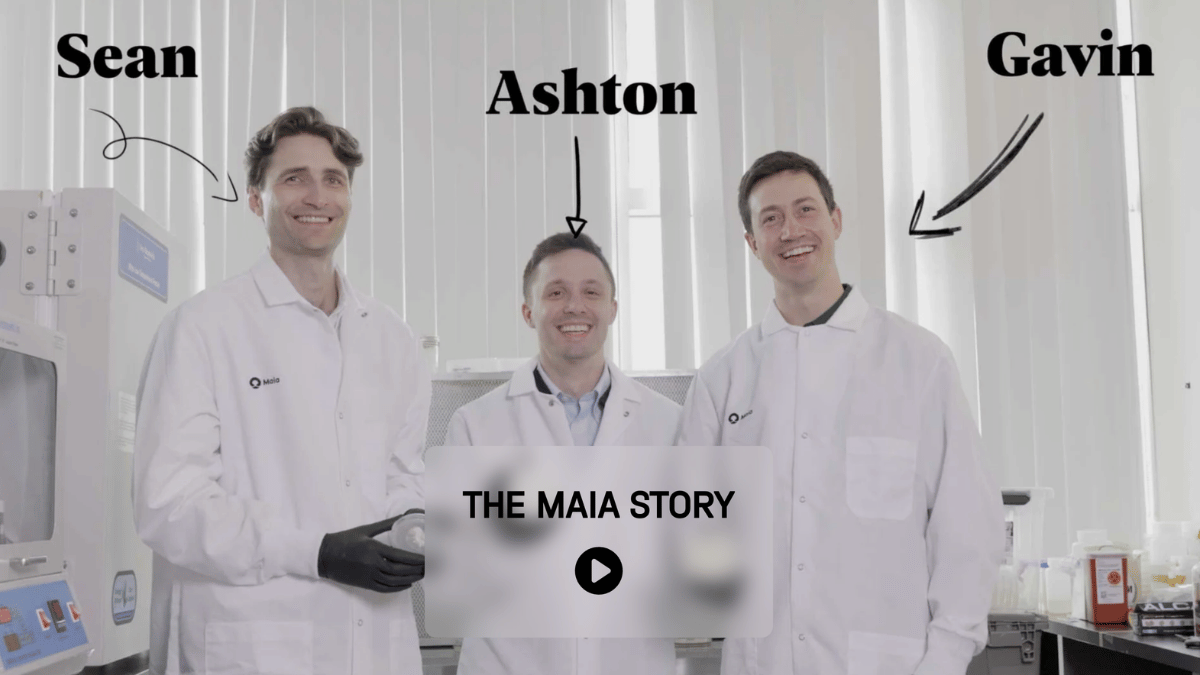
In an exclusive interview with Tomilli, Maia Farms Co-Founder Ashton Ostrander explains how research on food production for missions to the Moon and Mars gave rise to a company that uses fungi to develop healthy food.
How can healthy foods be made available for astronauts on long-duration space missions?
That question led the team behind Maia Farms to investigate a way to generate nutrients with few resources.
The project began during the pandemic, when the team, consisting of space engineers, neuroscientists and agricultural experts, participated in a competition focused on efficient nutrient production for space missions and potential settlements on the Moon and Mars.
With its competition proposal, the team became part of an ongoing debate: plant proteins vs. animal proteins, but instead of choosing one of the two, Maia Farms explored a third possibility.
“There’s usually an option C,” says Ostrander, who comes from a civil engineering and wastewater management background, experience that has translated to Maia Farms’ ingredient structure.
For Maia Farms, option C was fungi.
Now, what started as an exercise to feed people in space, is adapting to gravity: finding concrete, reproducible applications capable of operating on a mass scale.
Why fungi?
“Fungi possess an extraordinary metabolic versatility. By leveraging that biological capability, our fermentation platform bioconverts complex, non-traditional carbon streams into high-value functional ingredients with remarkable resource efficiency” Ostrander explains.
The initial space proposal consisted of using biomass fermentation to produce structured proteins, achieved by converting carbon into molecular packs rather than single molecules. Maia Farms’ goal is for the same ingredient to provide nutritional and functional characteristics that would otherwise require several components and suppliers.
“If you’re trying to create a product, and you need iron, protein, and fiber, these are actually coming from three different supply chains,” explains Ostrander.
Instead of relying on multiple suppliers for iron, protein, and fiber, Maia Farms’ products deliver these core nutrients within a structured protein via a single supply chain, which simplifies food labels and supply chain logistics
Did you know that texture defines a protein?
Texture is a central part of Maia Farms’ research: the company works with filamentous fungi because of its fibrous structure similar to those of meat products.
“[Fungi] is structurally closer to animal proteins than vegetable proteins,” Ostrander explains.
The company does not consider fungi to be a substitute for plant or animal proteins, but rather to be another option.
“That’s actually what we’ve been trying to do – reverse engineer the cow and come up with a way to find a fungi that is chemically identical to the protein profile of the cow,” says Ostrander.
“Plants can’t replace animal proteins because of the structure of the proteins. Plants are gummy and animals are fibrous. So, what happens is, gummy [textures] trigger a mechanism in our brain. So, no matter how well you dress up a plant protein burger… when we take bite our ancestral brain is like ‘ah something’s not right.’”
Ostrander also highlighted the irreplaceable role of livestock in consuming agricultural waste, explaining that cows cannot be eliminated from the global food chain because they play a fundamental role in organic waste stream management.
“So, the question is, how do we create this mechanism that can click into global food chains, take in all of this organic matter, and convert it into something that’s nutritious and that could be as good as the cow?”
Coming back down to earth
Upon winning the competition, the team decided to use the prize money to tackle another challenge: developing the technology at scale on Earth.
Maia Farms has explored applications of its innovation in soups, snacks, pet nutrition, and meat alternatives.
Working in such different categories has shown Ostrander that producing an ingredient is only part of the challenge. The daily scale of food production, transport and distribution requires complex supply chain solutions.
“Scaling here on Earth has actually been more difficult than building for the moon,” Ostrander says.
“The food chain is actually extremely hard,” he says, citing the volume of food that gets produced, brought into cities and consumed on a daily basis.
“Something that’s actually kind of impacted us recently is the reliance the food chain has on petrochemicals. And I don’t mean just like in regards to supply chain transport, like oil and gas. I’m referring to the ingredients that are used to preserve and protect or even just help process goods; like the carrying agents that are used to help things flow through pipes or components that are used to protect a lemon during shipment to keep it from rotting.”
“Even if we electrify all the machinery and all the trucks, we still have to rely on oil and gas, this finite resource, for how the food system works,” Ostrander adds.
The Future of Fungi
“I definitely think fungi is going to play a much larger role in the evolution of food,” Ostrander says.
“You’re going to see a lot of processed meats actually adopting fungi-based proteins to help improve products, and especially flavor profiles. Plant proteins bring this bitter compound and we see [fungi] as a natural flavor masker and binder to help plant proteins.”
Maia Farms focuses on commercial-scale B2B supply, partnering with manufacturers to deliver industrial volumes alongside specialized application support for teams onboarding cutting-edge functional ingredients.