


The Brazilian socio-environmental and climate education organization ECoCria partnered with Dugas Pizzaria, and the branding agency Nexa for a campaign using pizza deliveries to raise awareness about a global issue: food security. Nexa’s Lucas Damazio explained the proposal to Tomilli.
‘What’s going on? Where’s the missing slice?
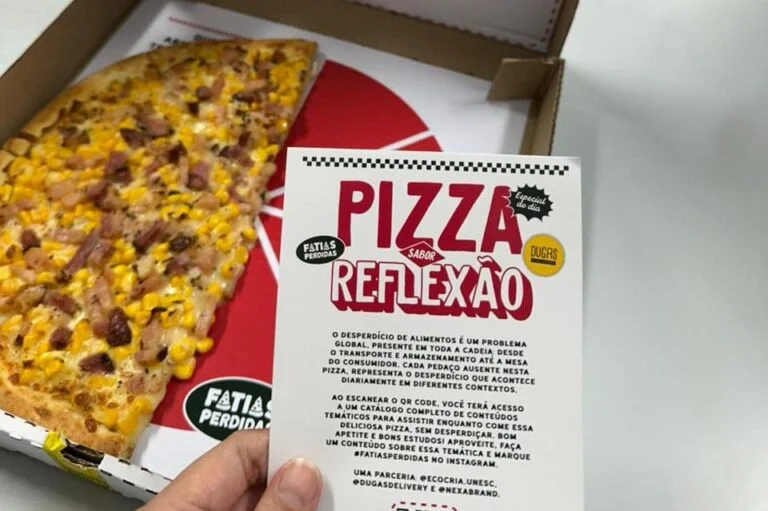
An incomplete pizza delivery prompts a reaction from consumers – they want an answer. The Wasted Slices campaign uses that bewilderment as a starting point for a conversation about food insecurity.
The initiative was launched in southern Brazil through a collaboration between ECoCria, Universidade do Extremo Sul Catarinense’s (UNESC) School of Communication; Dugas Pizzaria; and Nexa, which helped with campaign strategy and design.
In a conversation with Tomilli, Lucas Damazio, brand strategist for Nexa, explained that statistics do not always manage to bring an issue closer to home.
“The initiative started with a very simple question: How do you get people to really understand what food insecurity means?” For the team, finding that connection required thinking about an everyday experience.
“The problem is, numbers, even if they are huge, often lack the ability to generate an emotional reaction. We can talk about millions of people who do not have regular access to food, but it is difficult to imagine what that number represents in everyday life,” explains Damazio.
“From there, we looked for something we can all understand. Pizza is as an everyday thing associated with sharing. A pizza is usually divided and shared between people. Then we thought: What if a portion were missing?”
An absent portion to bring food insecurity closer to home.
The proposal changes the expectation: receiving a complete pizza to distribute slices evenly among those present. When a portion is missing, the experience of those who are going to share changes. “The absence of a single portion seems small, but when you have to share it, the experience immediately changes. It is no longer a statistic. It’s about feeling that something that should be there… isn’t,” Damazio says.
The intention was for consumers to feel the sense of lack and allow the reaction to appear before providing an explanation. “The campaign starts with a very simple idea: if a person can feel for a few seconds the lack of something as everyday as a portion of pizza, then maybe they can understand what it means for millions of people to not have something much more essential: A meal.”
“We didn’t want to compete with statistics. We wanted to give [the campaign] a human dimension.”
Recalling the reactions of the participants, Damazio highlights the journey from surprise to question. “The most interesting reaction was precisely the surprise. At first, people simply perceived that something was different. Then they understood that a portion was missing and began to ask why.”
That bewilderment gave way to a conversation and left the team with a learning experience about the possibilities for interventions. “One of our main takeaways was that we don’t always need to do something big to talk about a huge problem. Sometimes, a small modification to an everyday experience can generate a much greater reflection.”
“We also understood that sharing is a very powerful action. The idea of pizza is to share and bring people together around a table. By removing a slice, we alter an experience that we normally associate with abundance and conviviality.”
Creativity and education beyond the classroom
The educational dimension occupies a central aspect to the project’s approach. ECoCria’s participation links communication training with an experience developed together with a company and an agency.
“In addition, the project has a very important educational dimension. As it arises from the collaboration with ECoCria, it connects academic training with a real social challenge. We are especially interested in this relationship between knowledge and practice, because it shows how communication and creativity can leave the classroom and contribute to raising awareness about specific problems. For us, this collaboration also represents an opportunity to bring the university, the market and society together around a common purpose.”
That relationship to learning also appears in the way the team interprets audience engagement. Experience seeks people to ask questions about what happens at the table. “Another important takeaway was understanding that creativity can create situations for learning beyond traditional spaces. The experience transforms a complex issue into something tangible, capable of giving rise to questions and generating conversations between people who may have never stopped to think about food insecurity.”
Damazio links this learning to the academic origin of the initiative: “In this regard, collaboration with ECoCria is also essential. The project demonstrates how an initiative linked to communication training can connect academic knowledge with social reality and turn an idea into an impactful experience.”
From this perspective, innovation lies in the connection the campaign establishes between the problem and the way its perceived. “With ‘Wasted Slices’ the innovation was in transforming a statistic into a physical and everyday experience. The idea didn’t need us to explain too much.” This also leads to a question about the proposal’s continuity and what can happen after the first contact.
“I believe that social creativity needs to go beyond initial impact. Generating awareness is important, but true transformation occurs when that awareness becomes conversation, participation, and ultimately behavior.”
For Damazio, the responsibility of a social campaign includes considering its purpose, the context and the people involved, as well as possibilities for action.
Collaboration between the three organizations is part of that approach. “And I think that the construction of the project itself demonstrates the value of collaboration. A communication school provides knowledge and training; a company like Dugas provides its relationship with the real consumer experience; and an agency like Nexa provides strategy and design to turn the idea into a concrete experience.”
Wasted Slices and its projection after the 2026 Tomilli Summit
Recognized by the Tomilli Summit as one of the top innovative initiatives of 2026, Wasted Slices has an opportunity to take its proposal to other contexts.
“For the team, this recognition represents much more than a prize. It is the validation of an idea conducted locally that could resonant in different places and cultures,” says Damazio. The team hopes that this visibility will facilitate new connections and educational dimensions.
“We hope that this visibility will allow ‘Wasted Slices’ to reach more people, organizations, educational institutions, and projects interested in replicating or adapting the initiative to their own contexts.” Added to this expectation is an interest in broadening recognition for the role of the university:
“We also hope that recognition will contribute to providing visibility for the role of education in social transformation. The participation of ECoCria demonstrates that the university can be a space for experimentation, collaboration and the development of ideas capable of transcending academic environments.”
The possibility of reaching other places brings the conversation back to the initial purpose of the campaign.
“In the end, our goal was never to create an award-winning campaign. It was to find a way to make people perceive, even if just for an instant, what it feels like when something that should be at a table just isn’t there.”