



Just a few decades ago, the idea that engineering, physics and haute couture professionals would work together would have seemed far-fetched. However, these collaborations are currently giving rise to some of the most innovative proposals for contemporary design.
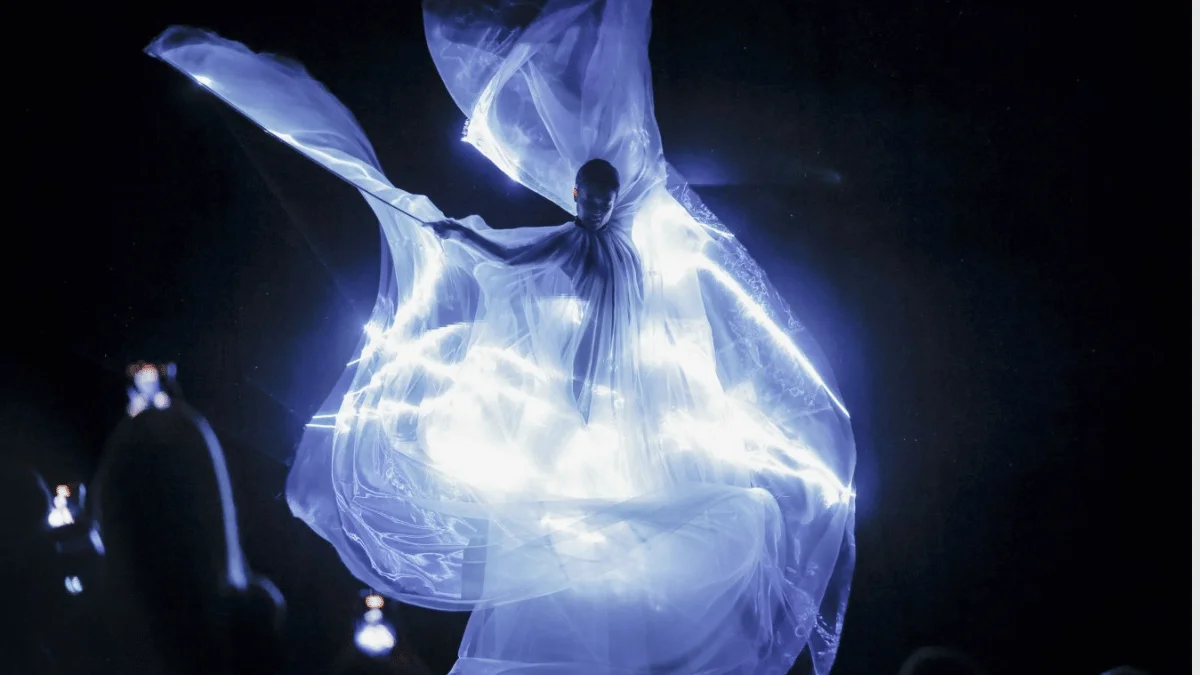
One of designer Iris van Herpen’s dresses has recently captured attention on social media due to its almost unreal appearance. Its structure seems to float, change form with movement, and many even believe it was created with Artificial Intelligence. However, the piece is part of the work by the Dutch designer, recognized for integrating science, technology and craftsmanship into each of her collections.
The design belongs to the Sonic Starquakes collection for Haute Couture Fall/Winter 2026-2027. Inspiration for the collection did not come from trends or traditional fashion references, but from natural phenomena.
For this collection, Iris van Herpen explored concepts such as the vibrations of stars and plasma — known as the fourth state of matter — to transform scientific principles into garments that challenge perceptions of movement and matter.
The starting point was starquakes or “stellar earthquakes,” vibrations that occur inside the stars and allow astrophysicists to study their structure, similar to how seismologists analyze the interior of the Earth. What normally remains invisible ends up becoming a moving silhouette.
To make this possible, Iris van Herpen turned to experimental materials, advanced manufacturing techniques and collaborations with scientists, engineers and researchers. For more than a decade, his studio has operated as a space for interdisciplinary experimentation where fashion coexists with disciplines such as physics, 3D printing, engineering and biology materials, constantly expanding the boundaries of design.
The designer herself explained her vision while presenting the collection:
“For years, I have been drawn to the idea of creating a garment woven solely with energy. We have shaped haute couture with solids, liquids, living matter and even gases. This is the first time we have worked with the fourth state of matter: Plasma. Glass and tulle still keep it connected to the ground, but we are one step closer to a haute couture that exists as an atmosphere.”
One of the most striking moments of the show came with Helix Nebula, a dress that incorporates plasma contained in glass tubes. When a person approaches, the plasma responds to the electromagnetic field of the human body and light seems to follow its movements, turning the garment into an interactive experience where fashion and physics meet.
Beyond the spectacular nature of her designs, van Herpen’s work reflects how innovation in fashion no longer depends solely on fabrics, patterns or trends. Today, fashion innovation also arises from collaborations between designers, physicists, engineers, scientists, and specialists.
In this context, haute couture ceases to be understood only as an aesthetic discipline and becomes a space for research and experimentation. Iris van Herpen’s designs show how creativity can be enriched by studying science, giving rise to garments that not only seek to impress on the runway, but also to expand the boundaries of what design is capable of.
Source: Iris van Herpen