



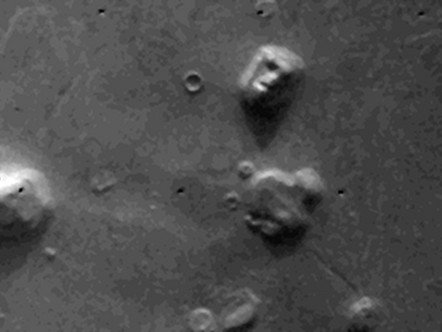
Pareidolia is the psychological phenomenon that makes us see familiar faces, figures, or patterns in everyday objects: an animal-shaped cloud, an electrical outlet that “smiles” or the famous “face” on Mars captured by NASA. Our brain is programmed to recognize faces quickly, and sometimes it fills in the information even though it doesn’t really exist.
This mechanism has an evolutionary basis: Identifying faces and signals quickly increases chances of survival. But in the modern world, pareidolia is not only curious… it’s also useful.
– Advertising and Branding: Designers create logos and packaging that suggest hidden shapes or “friendly faces” to generate immediate emotional connection.
– UX and digital design: Intuitive interfaces take advantage of familiar patterns so that the user understands functions without a manual.
– Artifical Intelligence: Machine vision systems are trained precisely to avoid pareidolia errors and distinguish real patterns from visual matches.
– Creativity: Artists and creators exploit this phenomenon to generate impact and conversation.
In an era dominated by image and AI, understanding how we perceive patterns is not trivial: it is strategic. Pareidolia shows that often times, we don’t see the world as it is… but how our brain needs to interpret it.
Tomilli