


Artificial intelligence (AI) is changing the way ideas are originated, how campaigns are developed, and how creative processes evolve. But the real debate goes beyond technology, and revolves around creative leadership, good judgment and role women will play in the industry’s future.
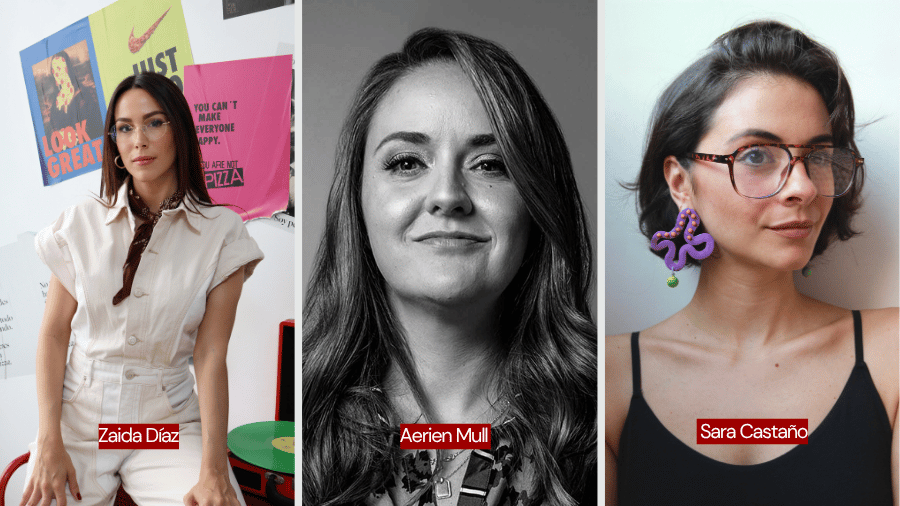
To analyze the panorama, Tomilli brought together three female leaders from different markets and disciplines: Zaida Díaz, of Monroe Pizza (Spain); Aerien Mull, executive creative director for Fors Marsh (United States); and Sara Castaño, creative director of Mutato (Venezuela). Based on their personal experiences, these industry leaders were asked to share their perspectives on the impact of artificial intelligence, the challenges of being a woman in a leadership role, and the conversations pending within the industry.
Although their perspectives are different, all three women agreed on one point: the future of creativity will depend less on tools and more on the human capacity to exercise good judgment, intuition and critical thinking.
Artificial Intelligence: A tool that demands more criteria, not less
Aerien Mull, executive creative director at Fors Marsh, says artificial intelligence will not replace the capabilities that make creative work truly valuable.
“Storytelling, experience, good taste, judgment, and knowing when to not use AI are profoundly human skills.”
Rather than mastering a new technology, Aerien believes that the challenge will be in strengthening those capabilities that no tool can automate.
Zaida Díaz, of Monroe Pizza, directs the conversation towards another aspect that she considers equally important: the biases with which artificial intelligence systems are trained.
“One of the biggest challenges lies not in developing increasingly powerful AI, but in making sure that it is trained with a more diverse, balanced and representative vision.”
Díaz says technology will never be completely neutral if it learns from data generated by a society that maintains inequalities.
Meanwhile, Sara Castaño, of Mutato, warns that the greatest risk lies not in losing one’s job to artificial intelligence, but in losing the ability to think independently.
“The biggest risk that this technology brings is not that it will take away our jobs, but that it turns us into bureaucrats.”
For Castaño, creativity will continue to belong to those who are capable of questioning, making people uncomfortable, and building ideas that no algorithm could come up with.
“The leadership of the future belongs to anyone who maintains an edge of rebellion, the stomach to defend what is uncomfortable, and the ability to create a visceral idea that no algorithm could anticipate, but that will surely help you execute [a successful campaign].”
Together, their responses reflect a clear takeaway: artificial intelligence will be able to execute tasks faster, but creative leadership will depend on good judgment, intuition and a human capacity to make decisions.
Female leadership: more than a position, it’s having the power to make decisions
All three women say there has been progress, but they also agree that increasing the number of women in managerial positions is not enough: change must be reflected in their real ability to influence, make decisions and transform organizations.
Castaño says that, “the day organizations understand that a female Creative Director at the top is not unconventional, nor an extraordinary exception to be applauded, but a standard of excellence for a business based on criteria, we will have reached 2030.”
Mull added that leadership does not equate to the loudest voice in the room. “I would like for leadership to recognize not only the loudest voice, but who constantly improves the quality of work and the people around them.” She highlighted the importance of promoting work models that allow women to continue growing professionally while attending to the other dimensions of their lives. In this sense, she says that “more organizations will manage to retain female talent when they recognize that flexibility and leadership are not opposing concepts.”
Zaida encourages women to not stay within their comfort zones. “As women, we still have to be a little more rebellious. Questioning more, making ourselves more uncomfortable and not accepting the status quo just because it has always been that way. In the end, creativity consists of precisely that: challenging the established norm.”
The conversations the industry still needs to have
While the presence of women in the creative industry has increased in recent years, all three believe that there is still a difference between participating and having real executive power.
Mull says women are often invited into conversations, but they don’t receive the group confidence to make decisions.
“Women are often invited into conversations to provide perspective, but there’s a difference between asking for their opinion and trusting them to make the decision.”
Mull added that:
“The creative industry does its best work when diverse perspectives help build ideas from the beginning and do not simply validate them at the end.”
Díaz shares this sentiment and believes that many professionals continue to put too much energy into demonstrating their ability.
“Sometimes we invest too much energy into proving that we are good enough and too little in doing the work we really want to do.”
Castaño proposes a complementary approach. She believes the goal should not be to keep separate spaces for women, but to build an industry where talent is the only criterion for evaluation.
“It’s not about maintaining a parallel field out of obligation, but about understanding that talent and the ability to create have no gender, and that a good idea is a good idea, whoever it comes from.”
She recognizes that exclusive spaces continue to be necessary to generate visibility and accelerate change, but hopes that, in the future, women will naturally participate in conversations about creativity, leadership and innovation, without the need to constantly justify their presence.
Leadership also means transforming
Based on Díaz, Mull and Castaño’s reflections, the future of creativity will depend not only on technological advances, but on the ability of people to exercise leadership with good judgment, critical thinking skills, and a broader vision.
At a time when artificial intelligence redefines the way we create content, all three agree that the real challenge lies in building an industry where women not only occupy more spaces, but where they can have influence, make decisions and lead without being considered an exception.
After all, if creativity is about questioning the status quo, transforming the structures of the industry itself should also be understood as one of its most important exercises.
Written by: Gabriela Carmona Rivera