


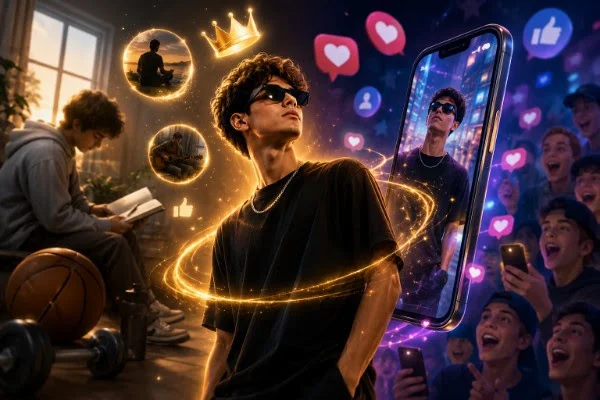
From viral meme to cultural phenomenon, “aura farming” reveals how younger generations are turning attitude, presence and social validation into a new form of digital capital.
- The phenomenon emerged and grew across social media as an ironic way of measuring someone’s “aura” or presence, particularly when an action projects confidence, style or charisma and earns recognition from other users.
- Beyond being just another piece of internet slang, “aura farming” reflects a shift in how younger generations construct identity: every gesture can become content, every moment an opportunity to generate social buzz, and every audience reaction a kind of digital status score.
By Rodrigo Pujol Del Toro, communications specialist (@rodrigopujol)
Some expressions begin as ways to describe a behavior and end up becoming mirrors of an entire generation. “Aura farming” is one of them.
The term, now appearing across TikTok, Instagram, X and everyday conversations among young people, combines the logic of gaming with a distinctly contemporary obsession: building, managing and projecting a particular perception of ourselves in front of others.
Put simply, “aura farming” means doing something that increases the perception of your charisma, confidence, style or personal magnetism. Cambridge Dictionary already recognizes aura farming as slang, defining it as doing things with the intention of displaying a personality that others find attractive or interesting, particularly on social media.
The word “farming” comes from gaming culture. In video games, farming means repeatedly performing certain actions to accumulate resources, experience, items or points. Digital culture has taken that logic and applied it to personality: if you can accumulate experience in a game, you can now — symbolically, at least — accumulate “aura.”
In other words, charisma has become a kind of social stat. Merriam-Webster explains this combination of aura, understood as coolness or appeal, and farming, associated with accumulating resources through repeated actions.
And this is where one of the phenomenon’s most interesting elements appears: the imaginary existence of “aura points.”
A look, a clever response, a dramatic entrance, an unexpected skill or even the way someone dresses can earn them “+1,000 aura.” Falling over, giving an awkward response or trying too hard to look interesting might cost them “-5,000 aura.”
There is no official scoreboard, of course — and that is precisely where much of the humor lies. Merriam-Webster notes that Generation Alpha has turned aura into a kind of coolness factor, giving rise to expressions such as aura points and aura farming.
From Gaming and Anime to a Global Phenomenon
The concept did not emerge out of nowhere, nor does it have one clearly documented creator. Its popularity began growing around 2024 within online communities connected to gaming, anime, memes and digital culture. Merriam-Webster identifies anime fandom as one of the spaces that helped popularize aura farming as a way of describing characters or people who project an especially powerful or compelling presence.
But the phenomenon reached a global scale in 2025 thanks to an image that was difficult to forget: a boy dancing on the bow of a traditional boat in Indonesia.
Rayyan Arkan Dikha, then 11 years old, was performing as a dancer during the traditional Pacu Jalur boat races in Riau. His role aboard the boat was to perform movements that energized both the rowers and the crowd.
The combination of balance, composure, traditional clothing and rhythmic movement made him the perfect embodiment of what the internet had come to call “aura farming.” Cambridge now even uses the video as an example of the concept.
The phenomenon demonstrates something fundamental about digital culture: the algorithm does not always need an explanation; it needs an image that is recognizable, reproducible and capable of becoming a meme.
Dikha’s dance was remixed, set to different music and recreated by users around the world. International media documented how an image rooted in a local Indonesian tradition became part of a global visual language.
The regional government of Riau even acknowledged the cultural impact of its virality. According to Riau Media Center, one video of the competition had reached more than 58 million views and 1.6 million likes by August 2025.
The Bigger Insight: “Aura” Cannot Necessarily Be Manufactured
From my perspective as a communications specialist, says Rodrigo Pujol Del Toro, this is where the phenomenon becomes most fascinating.
Aura farming may appear to be about performance, but it is also about authenticity.
The paradox is that someone can deliberately try to look spontaneous. They can carefully consider the pose, clothes, music, facial expression, the way they walk or even the exact moment they should appear indifferent in front of a camera.
But the more obvious the effort becomes, the greater the chance that the digital community will respond with: “They’re trying too hard.”
Cambridge even acknowledges this tension in its definition: while aura farming may work on social media, deliberately doing it in real life also carries the risk of being mocked or considered cringe.
This creates a new cultural rule: true digital status comes from appearing as though you are not seeking status at all.
And that has major implications for contemporary communication.
For decades, advertising taught us that building a brand meant controlling the message. Then social media showed us that audiences also shape brands. Now, phenomena such as aura farming take that logic all the way to individual identity: every person becomes a small personal brand tasked with managing public perception.
From Likes to “Aura Points”
For years, we have measured digital popularity through followers, likes, comments, views and shares. Now younger generations are developing a far more abstract language to measure something that has always existed: social capital.
You do not need to say someone is charismatic. You can simply say they have “aura.”
You do not need to explain why someone did something impressive. You can say they gained “+10,000 aura.”
You do not need an elaborate critique of an embarrassing moment. You can simply say someone lost all their aura.
It is a symbolic economy turned into a meme.
What makes this language particularly interesting is that it allows younger people to talk about social hierarchies, attractiveness, popularity and reputation without necessarily treating them seriously. Humor becomes the translation mechanism.
That is why I believe “aura farming” is much more than a viral expression. It is a new way of narrating identity.
What Does This Say About Generation Z and Generation Alpha?
We are looking at generations that grew up surrounded by interfaces, video games, memes, influencers, streamers and algorithms. For them, the boundary between real life and its digital representation is far more porous.
A teenager can simultaneously think about how they are experiencing a moment and how that same moment might look in a video. That does not necessarily mean everything is fake. It means the camera has become part of the social environment.
The concept of aura also introduces an important distinction: it is not simply about being popular; it is about making an impression.
You can have few followers and still have “aura.” You can be famous and lose it in five seconds. You can do something completely ordinary and turn it into a memorable scene.
That changes the meaning of influence.
Having an audience is no longer enough. You need presence.
And Then Came the Aura Battles
In 2026, the phenomenon took another step forward: it moved beyond screens and began turning into a physical spectacle.
Across parts of Latin America, videos began circulating of so-called “aura farming battles,” where young people face off using poses, gestures, movements and attitudes to determine who projects the strongest presence. Media outlets including El Financiero, Excélsior and La Nación have documented the recent spread of the phenomenon.
It is a particularly revealing evolution: what began as a way of describing a video has turned into a social activity that can be physical, competitive and participatory.
We are watching internet culture bring its codes back into the streets.
First came memes. Then dances. Now, “aura.”
Passing Trend or New Cultural Language?
The expression “aura farming” will probably evolve, be replaced by another term or disappear from conversations within a few months. That is normal in digital culture. The speed at which words emerge and disappear is part of the ecosystem.
But the behavior it describes is unlikely to disappear.
Because behind the meme lies a very old human need: we want to be seen, recognized, admired and remembered.
What has changed is the language.
We once spoke of prestige, reputation, presence, personality, charisma or magnetism. Today, we can simply say: “They have aura.”
And perhaps that is the real reason the concept resonates so strongly with younger generations: it reduces a complex idea to a single word that can instantly become a meme.
The Phenomenon Also Represents an Opportunity for Brands
From a communications perspective, aura farming offers a particularly relevant lesson.
Brands that try to force themselves into the trend will probably lose precisely what the phenomenon rewards: authenticity.
A brand cannot simply put “+1,000 aura” in an ad and expect an entire generation to find it relevant. It needs to understand the cultural codes behind the term: spontaneity, humor, aesthetics, irony, participation and, above all, the ability to create a moment people genuinely want to share because they find it funny, compelling or impressive.
The Pacu Jalur case is particularly revealing. A local cultural tradition became an international phenomenon not because it was originally designed as a global campaign, but because audiences discovered a powerful image and chose to appropriate, remix and redistribute it. ANTARA documented how the phenomenon even generated new tourism and cultural interest around the tradition.
That is one of the biggest lessons of today’s digital ecosystem: virality cannot always be manufactured; sometimes, all you can do is create the conditions for it to happen.
The Real Question Is Not How Much Aura We Have
As a communications specialist, I believe this phenomenon deserves to be taken more seriously than its seemingly absurd appearance might suggest.
Because behind the poses, memes, “+1,000 aura” comments and street battles is a generation learning how to construct identity in public.
And that raises a question that goes far beyond TikTok:
Are we building who we are, or are we learning to build the version of ourselves we want other people to see?
Perhaps aura farming is simply another internet trend.
Or perhaps it is one of the most precise expressions for describing an era in which identity itself can be edited, posted, shared, measured and, of course, farmed.
— Rodrigo Pujol Del Toro, communications specialist
Sources consulted: Cambridge Dictionary, Merriam-Webster, Riau Media Center, ANTARA News, El Financiero, Excélsior, La Nación and digital culture media.