



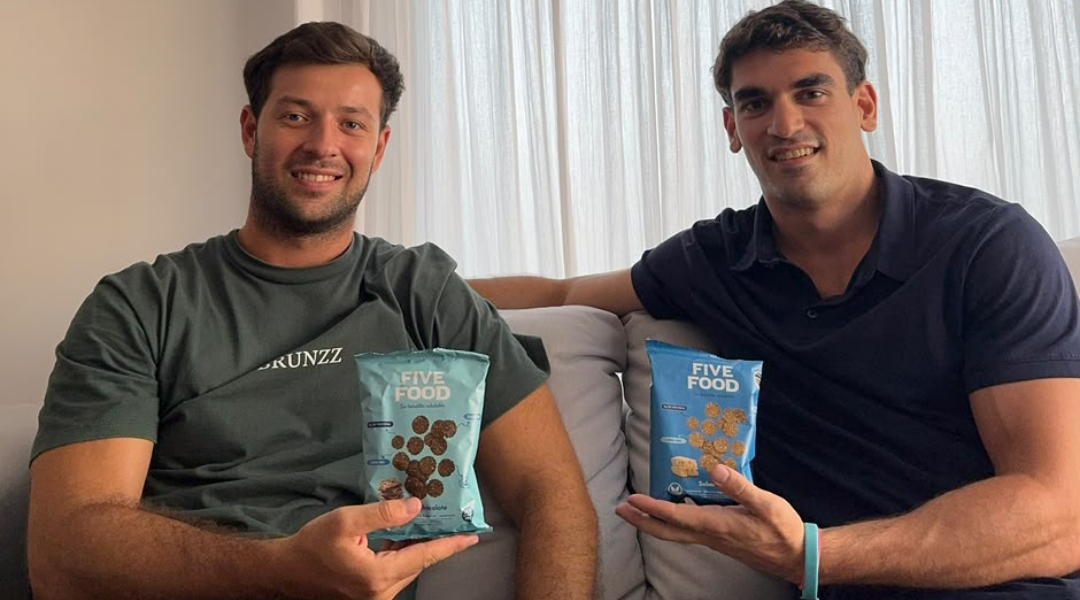
‘Five Food’ started as a thesis project. It soon found its market niche between traditional snacks and healthy alternatives.
Finding healthy snacks, that are nutritious, accessible and tasty, has been a challenge in Argentina. The products available on the market often force consumers to choose between flavor and nutritional quality. The founders of Five Food identified this market niche while working on their university thesis. Soon consumer response revealed a real commercial opportunity: a product for those looking to take care of themselves without giving up the pleasure of snacking.
After close to three years of development, Five Food created baked snacks, high in protein and fiber; a salty proposal capable of competing with traditional products like chips.
In a conversation with Tomilli, the Five Food team explained how it transformed an everyday need into a company, revealed the challenges entailed while developing its products, and provided insight into the trends redefining health foods in Argentina.
From a thesis project to a health food company
At what point did you realize that the idea could become a company?
Five Food started as a thesis project that received very good feedback. So, we started conducting surveys and realized that there was a demand among the Argentine population for this snack concept — tasty, healthy and available as a fast snack. We identified a real vacuum in the market that nobody was satisfying.
Once on the market, we validated the product by attending multiple fairs around the country and using product samples as a testing tool. People responded positively, and we started selling the product on a mass scale.
The transition from a thesis to a company was supported by direct consumer validation: First through surveys and then through direct contact with consumers at fairs in different regions of the country.
Taste and nutrition: the challenge of creating a healthy snack
How do you ensure that a snack is healthy and, at the same time, has an attractive taste and texture?
They are 40 gram-baked snacks (not fried), with pea and rice protein, high in protein and fiber, without gluten (no Wheat, oats, barley nor rye), vegan, without trans or saturated fats, without preservatives, and made with fewer than ten ingredients.
We strive for a baked texture, that’s not dry, like a typical protein bar, with a salty, cheese flavor. It is the first salty protein snack in Argentina, which allows us to compete with traditional snacks, such as fries, rather than other protein bars.
We spent almost three years developing the product we have today.
Five Food’s innovation doesn’t lie solely in its ingredients, but also in the way it has managed to create a consumer experience that can compete, both in taste and texture, with snacks traditionally associated with entertainment and impulsive consumption.
Sports as a starting point for Five Food
What role did sports play in the creation of Five Food and in the consumer profile you initially targeted?
We are both amateur athletes. We have always enjoyed eating well. We pay attention to what we consume, trying to maintain certain nutritional parameters, without becoming obsessive.
The problem was that when we wanted to buy something fast, 90% of the options available were ultra-processed and of very poor nutritional quality. And if you looked for something healthier, it ended up being bland and tasteless.
We found that there was no happy medium. We wanted to enjoy our food and not be overly-strict, but also not give up on nutritional preferences. The only real option was a typical protein bar, but that’s a market that is already oversaturated.
Five Food was launched due to that lack of a middle ground. First, we targeted consumers like us: athletes, who seek performance and nutritional values that don’t want to resign when it comes to taste, nor obsessively track consumption.
This personal experience initially defined the brand’s consumer target: active people who pay attention to their diet.
The challenge of offering healthy, yet accessible, snacks
What has been the greatest challenge in developing healthy, accessible snacks?
Finding the ingredients that allow us to make the product we want in terms of taste, texture and nutrition, while still remaining within certain cost parameters to remain accessible. That was, and still is, the most complicated aspect of the business.
The challenge reflects one of the main dilemmas of the industry: ensuring that nutritional innovation does not price-out the average consumer.
The trends transforming healthy eating
What health food trends do you think are changing consumption habits and which do you think are temporary?
Protein as the central macronutrient – not just “low calories” – and saltiness as a new category within health, which is currently dominated by sweets.
A passing trend that, in my opinion, has been losing strength, is the keto diet.
For Five Food, the evolution of the health food market is characterized by consumers who pay attention to the ingredients in products and are interested in salty proposals in a category historically dominated by sweet protein bars.
The Future of Five Food in Argentina
What would you like Five Food
to represent within the next generation of healthy food brands in Argentina?
We want to be the brand that is part of Argentine consumers’ daily lives.
A new generation of healthy snacks in Argentina
Five Food exemplifies how an everyday need can be
turned into an opportunity for innovation.
After almost three years of development, the brand seeks to occupy the space between traditional snacks and real food, betting on a proposal that combines nutrition, flavor and accessibility.
The brand’s goal is to not to be limited to fitness consumers, but to become a part of the daily habits of those who want to eat better without giving up the guilty pleasure of snacking.
This conversation is part of the editorial and curatorial work of Tomilli Summit Dubai 2026, an international platform that identifies and brings together initiatives capable of transforming industries, habits and markets through innovation.


