



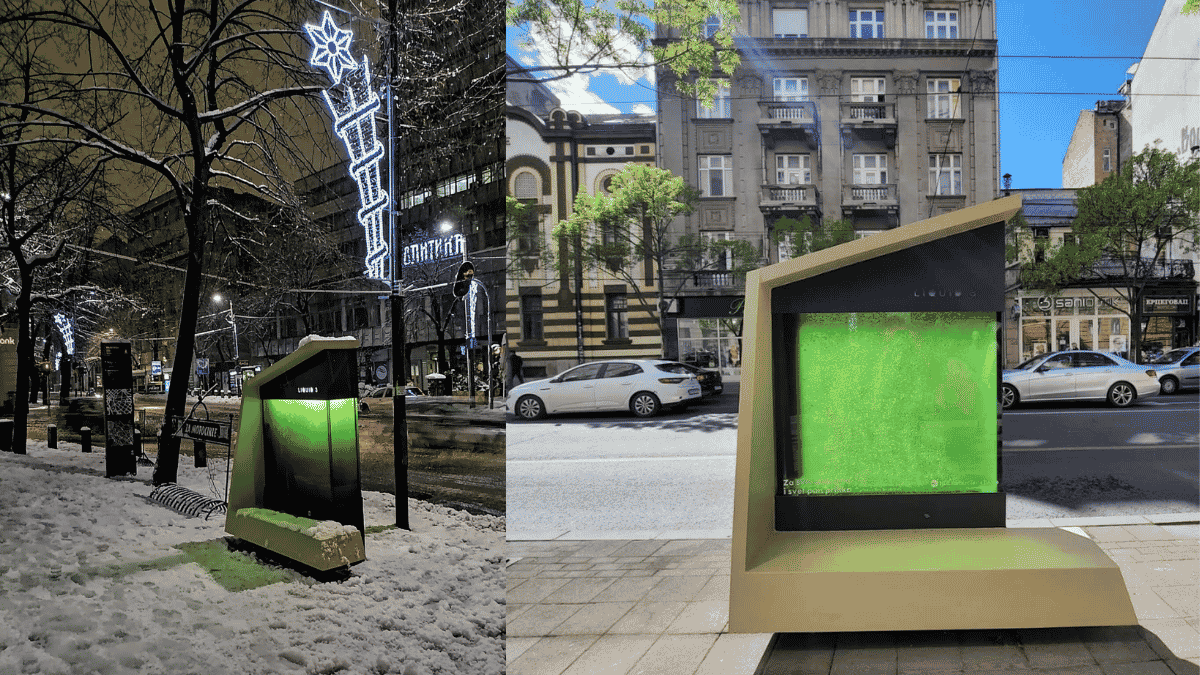
Is it possible to bring photosynthesis to cities when there is no space to plant trees?
That question gave rise to LIQUID3, an innovative photo-bioreactor developed by researchers at the Institute for Multidisciplinary Research at the University of Belgrade in Serbia.
Popularly known as the “liquid tree,” this system uses microalgae to absorb carbon dioxide (CO₂), release oxygen, and improve air quality in highly urbanized environments.
Unlike a conventional tree, LIQUID3 consists of a transparent tank filled with water and microalgae. These microorganisms photosynthesize naturally; removing CO₂ from the environment, producing oxygen, and generating biomass, replicating one of the essential functions of vegetation.
But the project goes beyond carbon sequestration. The device is powered by solar energy, incorporates LED lighting and has been incorporated into street furniture. People can even use it as a power bank and charge electronic devices via USB ports.
Not a replacement
Its creators insist on a fundamental point: LIQUID3 does not seek to replace trees.
Forests and green areas remain irreplaceable because of the environmental benefits they offer, from temperature regulation to biodiversity conservation to shade. The goal of this technology is to bring photosynthesis to spaces where planting trees is practically impossible, such as narrow streets, highly paved areas or sectors with underground infrastructure.
Throughout 2026, LIQUID3 has garnered interest from architects, urban planners and public administrations as a complementary alternative for tackling air pollution in urban environments.
Although its implementation is still limited, the project demonstrates how biotechnology can be integrated into urban design to expand sustainability strategies in increasingly crowded cities.
The solution to climate change will continue to be to protect forests, restore ecosystems and increase green areas. However, initiatives such as LIQUID3 show that innovation can also provide new tools for improving air quality where nature faces greater limitations.
Do you think that technologies such as the “liquid tree” should be part central to urban design?
Source: LIQUID3