



According to Colombia’s Ministry of Health and Social Protection, cervical cancer affects about 3,800 women in the country each year. When detected early, cervical cancer can be prevented and treated with a high probability of success. However, for many women living in Colombia’s rural areas, accessing a timely diagnosis remains a challenge.
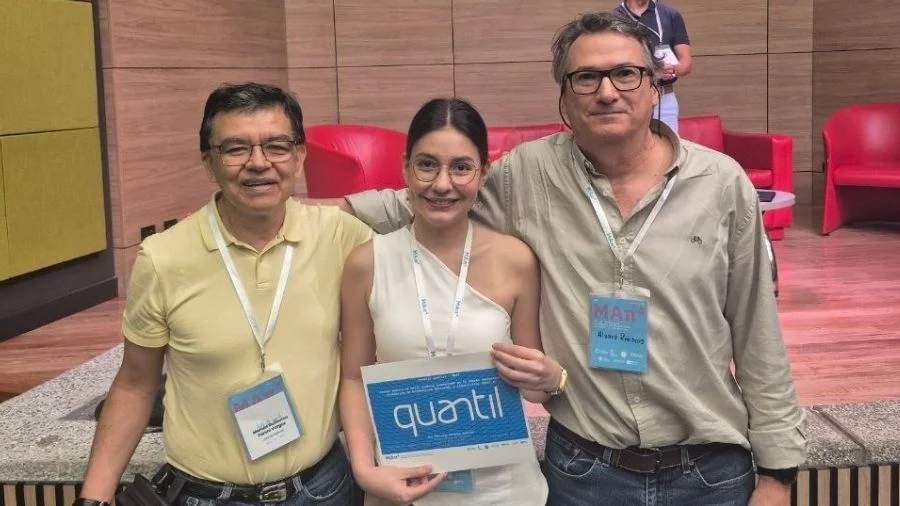
Ana Gabriela Borrero Ramírez, an Electronic Engineering student, had this reality in mind while taking an Artificial Intelligence class at the University of Ibagué, in which she was able to explore and connect with her institution’s research center for cervical cancer. That is when she started to ask herself how technology could become an ally to help these women. The answer led her to develop an application based on Artificial Intelligence called CervixIA that is able to classify images with a 97.96% accuracy rate. The app won third place at the Congress for Applied and Industrial Mathematics (Congreso de Matemáticas Aplicadas e Industriales – MAPI4).
The 23-years-old says “there was always this interest in innovating, creating and seeing how ideas could become something tangible. When I learned about artificial intelligence, I understood that there were many possibilities there to develop real solutions.”
What began as research on neural networks ended up taking an unexpected direction when Borrero identified the public health problem that few people were addressing. As a result, the team began developing an application that could become a practical tool for doctors working far from large hospitals.
“The application can be used on a computer, does not need Internet access and delivers results in approximately thirty seconds or maximum two minutes. The idea is for the doctor to have a support tool to make decisions faster,” explains the student.
Far from replacing a healthcare professional, CervixIA analyzes cytology images, identifies cells, and provides visual support to facilitate medical evaluation.
“The application counts the cells and generates a kind of traffic light. In addition, the doctor can check each cell, zoom in, and see why the neural network made a certain decision.”
However, developing the algorithm was only part of the challenge. Ana Gabriela is not a health professional, so she consulted with specialists who helped her ensure that the app could interpret the medical context behind the image.
Ana Gabriela thinks that if she had the necessary resources, she would work hand in hand with a gynecologist or a clinic to further strengthen the app, in order to help more women access a timely diagnosis.
Ana Gabriela is convinced that, by working together, medical professionals and app developers could accelerate solutions for thousands of people, creating tools that facilitate healthcare.
Despite the limitations and lack of medical support, the effort paid off. The CervixIA app won third place at the Congress of Applied and Industrial Mathematics (MAPI4), competing against master’s and doctoral research.
Ana Gabriela says she felt proud to be the only woman so young in such an important space. “My project achieved third place and proved that it is possible, even as a woman from a regional university, to be an engineer.”
Throughout this process, Gabriela realized that innovating does not only mean developing technology. It means finding solutions where others haven’t looked. And, although CervixIA is already functional, its really just getting started. She hopes to continue improving upon the app, validating information with hospitals and health professionals, incorporating new tools, and making it a real support for doctors in the future, thereby helping more women access a timely diagnosis.
If you are a health professional, researcher or part of a hospital, clinic or institution interested in learning more about this project and exploring possible opportunities for collaboration, you can contact Ana Gabriela Borrero through her LinkedIn profile. Initiatives like this demonstrate the value of bringing together engineering, research and medicine to develop solutions that respond to the challenges of the health system.
Source: Colombia’s Ministry of Health and Social Protection. National Cancer Observatory – General information: cervical cancer. Ministerio de Salud y Protección Social de Colombia. Observatorio Nacional de Cáncer – Información general: cáncer de cuello uterino.
Written by: Gabriela Carmona Rivera


