



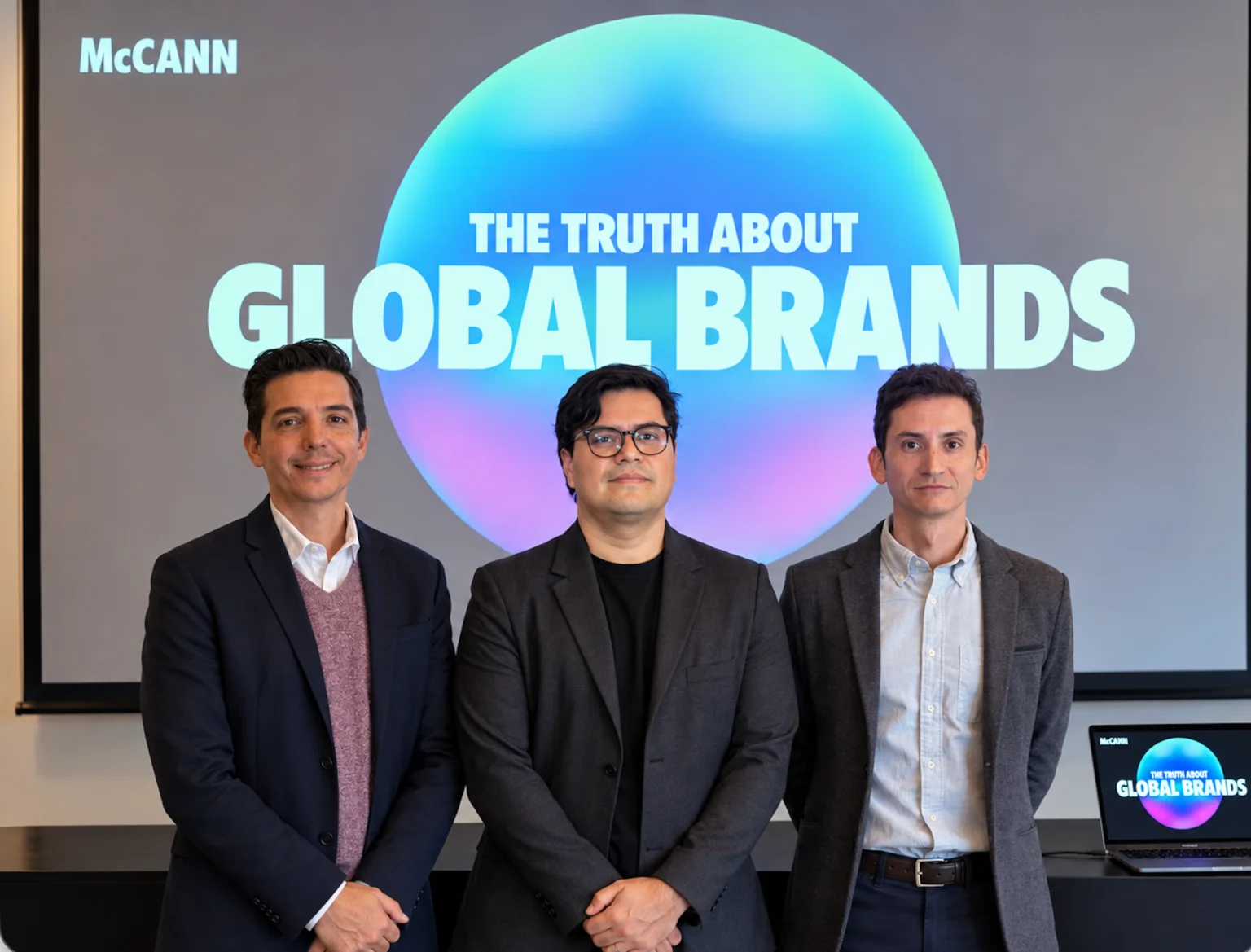
A study realized by McCann and the Economist Enterprise, reveals that global growth will be driven by a brand’s ability to increase consumer confidence
McCann Mexico recently presented a study, The Truth About Global Brands, which reveals a fundamental shift in the way brands achieve growth and global relevance.
The study, conducted in 20 countries, was based on independent insights from Economist Enterprise, the B2B (Business -to-Business) arm of The Economist Group.
The research reveals that brands must help consumers navigate an increasingly complex “Labyrinth of Truth,” eradicating consumer doubts to drive growth.
“The Mexican market today demands a clear response to the global [consumer] confidence crisis: we are moving from an economy based on blind faith to an economy of permanent doubt, which subjects marketing directors to unprecedented business pressure. The new manual for building relevant brands is not limited to selling, but to accompanying with transparency; based on the ability to operate with extreme clarity, absolute credibility and a deep cultural fluidity that resonates in an authentic way with the reality of the local consumer at every moment of a decision” says Agustín Cárdenas, Executive Vice President at McCann Mexico.
The “Labyrinth of Truth”: A New Battleground for Brands
In the vast sea of information, consumers and business leaders are navigating a “Labyrinth of Truth”: a complex network of contradictory information, AI-generated content, and competing claims that has made it harder than ever to determine what is real.
– While 72% of people say that prioritizing the truth is more important than ever, 55% believe brands are less truthful than they were 20 years ago.
– 76% fear that they will soon not be able to distinguish between real and artificial people on the internet.
While AI is now expected — 72% of consumers and 88% of B2B leaders say brands must use AI to keep up — accountability is what will set brands apart.
- 53% of people say that being transparent about the use of AI is the most effective way for brands to build trust, and 45% says brands should help consumers understand what is real and what isn’t in AI-generated content
The business stakes are high, as research reveals that trust is not a nice-to-have, but a revenue driver.
The vast majority of people (80%) say they will actively choose brands they trust, even if they cost more, indicating an increasing credibility premium.
69% of consumers and 79% of B2B managers have stopped using a brand because they no longer trust it.
“Mistrust is not an abstract problem; it has a real and direct cost in the financial results of companies in Mexico. When a customer or business leader loses faith in a brand, regaining that relationship is almost impossible. In today’s environment, true growth belongs to brands that assume the role of allies of certainty and demonstrate their value with constant transparency,” says Joan Frías, Marketing, Communication and Consulting Director for McCann Mexico.
“Multimodal Globality” challenges the traditional brand-building manual
This study reveals a major shift in how culture and influence flow globally, as ideas move fluidly between markets, platforms, and communities.
– Influence is increasingly multidirectional, not from west to east
– Markets such as China, India and Saudi Arabia are shaping global standards
– 73% of people say you can be a global citizen without traveling
“Culture no longer travels in one direction; today it circulates smoothly, scaling from local contexts to interconnected global networks. Traditional brand building models have become obsolete; the Mexican market requires brands to be an active part of the cultural dialog in real time to maintain relevance,”explains Luis Flavio Guerrero, Head of Planning at McCann Mexico.
The Next Growth Engine: The 1 Billion “Upward Class”
With multi-directional cultural influence, a new highly influential and expanding audience is defining a new era of brand growth: The Upward Class.
– 1.02 billion people worldwide
– USD $29.5 billion in annual purchasing power
– Highly motivated by progress, self-improvement, and upward mobility
Unlike previous generations, these consumers use brands not only to consume, but to point to progress, identity and belonging, reshaping the very meaning of status.
Ascending classes show less cynicism toward brands and a stronger belief in brands as tools for advancement, giving them a disproportionate influence in defining what growth will look like.
“Growth in Mexico no longer depends on the inertia of the past or recycling audiences; the real business engine is the truth. Through our Truth Well Told framework, we integrate meaning, culture and commerce into a single living system that turns authenticity into a measurable growth asset,” explains Juan Camilo Romero, Head of Strategy at McCann Mexico.
The new playbook for global brand growth
Among all the findings, one principle stands out: The brands that succeed in 2026 and beyond will not be the ones that say the most, but the ones that eliminate more doubts and connect with the segments that shape tomorrow’s demand. This requires:
– Acting as a trusted guide in a complex information landscape.
– Going back to the basics, delivering products and experiences that are relevant, useful, and that demonstrate their value.
– Identifying and securing engagement with emerging and high-growth audiences that believe in brands.
– Designing truth-based ideas that evolve with culture and scale across networks.
Research Methodology
The Truth About Global Brands is based on a survey of 20 people [from the United States, United Kingdom, Australia, Brazil, Canada, China, France, Germany, Italy, India, Japan, Mexico, Spain, the United Arab Emirates, Saudi Arabia, The Philippines, Singapore, South Korea, Thailand, and New Zealand], conducted between November 2025 and January 2026, and qualitative analysis by senior marketing leaders and global CMOs.
*Trend data is reported in similar terms, with the following markets [US, UK, Brazil, China, France, Germany, India, Japan, Mexico] during 2018, 2023 and 2026.


