



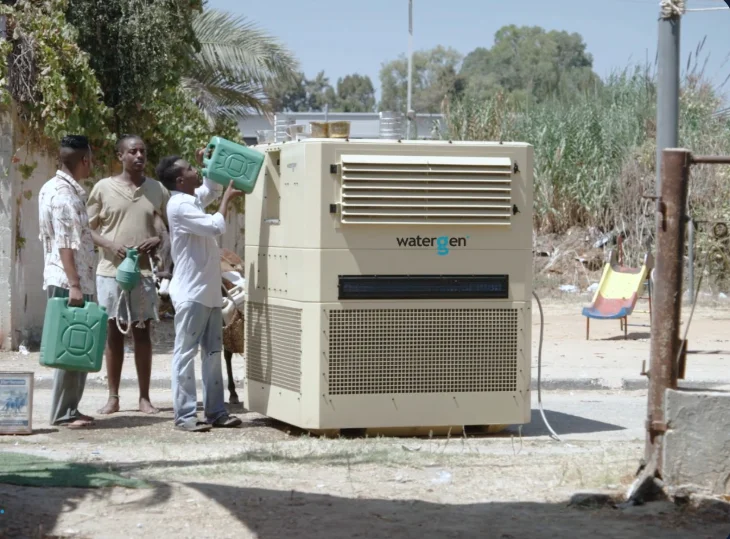
Can you imagine being able to extract drinking water directly from the air? It may seem like a futuristic idea, but one company has already achieved it.
Watergen has developed a technology capable of transforming humidity into high-quality drinking water by means of atmospheric generators that condense and purify the air. An innovation that demonstrates how technology can also rethink the way we access essential resources like water.
According to the UN, 884 million people do not have access to safe drinking water and only 0.01% of the Earth’s water is suitable for human consumption, a figure that continues to decline due to pollution growth.
The company offers sustainable solutions to address water scarcity globally, including:
- Unlimited large-scale water resources for governments, NGOs, armed forces, and humanitarian aid teams.
- Home and office: compact equipment that produces water directly indoors using existing air conditioning or the environment.
- Vehicles and emergencies: generators adaptable to trucks, vans, and other vehicles to provide drinking water in remote places or during natural disasters.
How does this seemingly idyllic process work?
- Suction: The system sucks in ambient air
- Filtering: Cleans the air by removing dust and dirt
- Cooling: Clean air cools quickly
- Condensation: Thermal shock converts moisture into liquid droplets
- Purification: Water passes through physical filters and ultraviolet light
- Mineralization: Essential minerals are added for optimal flavor
This technology provides a new option and opportunity to radically transform the world by decentralizing access to drinking water, and eliminating the need for traditional and invasive physical infrastructure, such as pipes, dams and tankers.
By producing pure water directly at the point of consumption, this innovation directly impacts geopolitics and global environmental sustainability.
Beyond Innovation
Watergen’s proposal presents new possibilities for decentralizing access to potable drinking water. By generating water directly at the point of consumption, it reduces reliance on complex infrastructure, such as distribution networks, tanker trucks, or long-range storage systems.
The possible impact of this type of technology includes:
- Reducing pressure on traditional water sources in regions facing scarcity
- Facilitating water supply during emergencies and humanitarian crises
- Supporting the development of isolated communities with limited access to basic services
- Reducing dependence on expensive infrastructure in certain geographies
Water access has become one of the great challenges of the 21st century, but initiatives such as Watergen demonstrate that innovation can solve global challenges based on invisible resources. Sometimes, the most disruptive solutions are in the air we breathe.
Sources:
Watergen – Water From Air
ONU-Hábitat
Tomilli selects what really generates impact.


