



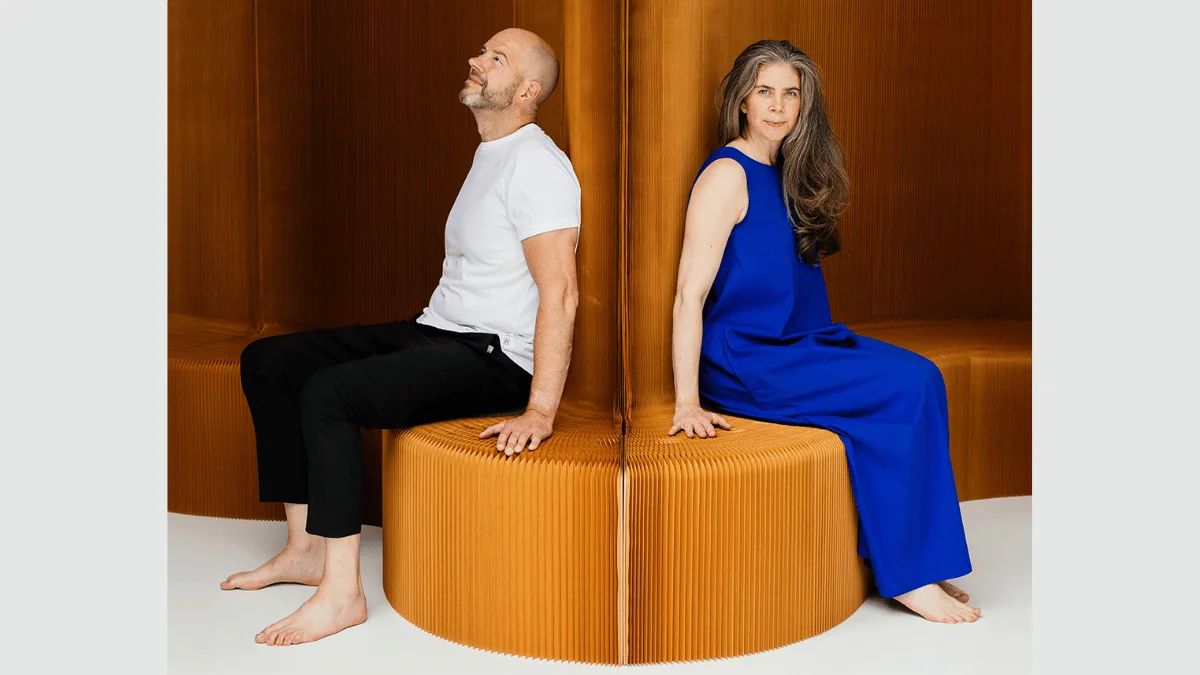
For decades, dividing interior spaces meant building walls or installing fixed partitions that limited how easily a space could adapt. Over time, solutions such as folding screens and accordion doors made it easier to reconfigure a room. But as homes became more compact and workplaces began demanding increasingly flexible layouts, a new need emerged: lightweight, versatile partitions capable of quickly adapting to different uses.
That was the approach taken by Canadian architects Stephanie Forsythe and Todd MacAllen, founders of design studio Molo. Rather than creating an entirely new type of room divider, they reinterpreted a familiar concept through an expandable honeycomb structure made from recyclable kraft paper and also available in textile versions.
The result was Softwall, a flexible partition that can be expanded in seconds, adapted to different configurations and compressed to occupy only a fraction of the space required by a conventional wall.
Thanks to its expandable structure, Softwall can be opened and closed repeatedly while maintaining its stability. The design makes it possible to transform the layout of a space within seconds, while also simplifying transportation and storage when the partition is not in use.
The concept responds to an increasingly relevant challenge in contemporary architecture: creating spaces that can transform without relying on permanent construction.
Beyond dividing environments in homes, offices, museums, galleries and commercial spaces, Softwall also offers sound-absorbing properties that can help improve acoustic comfort. At the same time, as a mobile and reusable solution, it can reduce the need for permanent renovations and the associated use of construction materials.
Among its recognitions, the project received Denmark’s INDEX Award, an international design prize recognizing solutions with a positive impact on society and the environment. The recognition highlighted how an idea based on relatively simple principles can respond to contemporary challenges involving flexibility, sustainability and the efficient use of space.
At a time when architecture and interior design are constantly adapting to new ways of living, working and collaborating, Softwall demonstrates that innovation does not always mean creating something entirely new.
Sometimes, rethinking a familiar solution is enough to create spaces that are more dynamic, functional and better equipped to respond to people’s changing needs.
Source: Molo